1. Study Objective & Overview
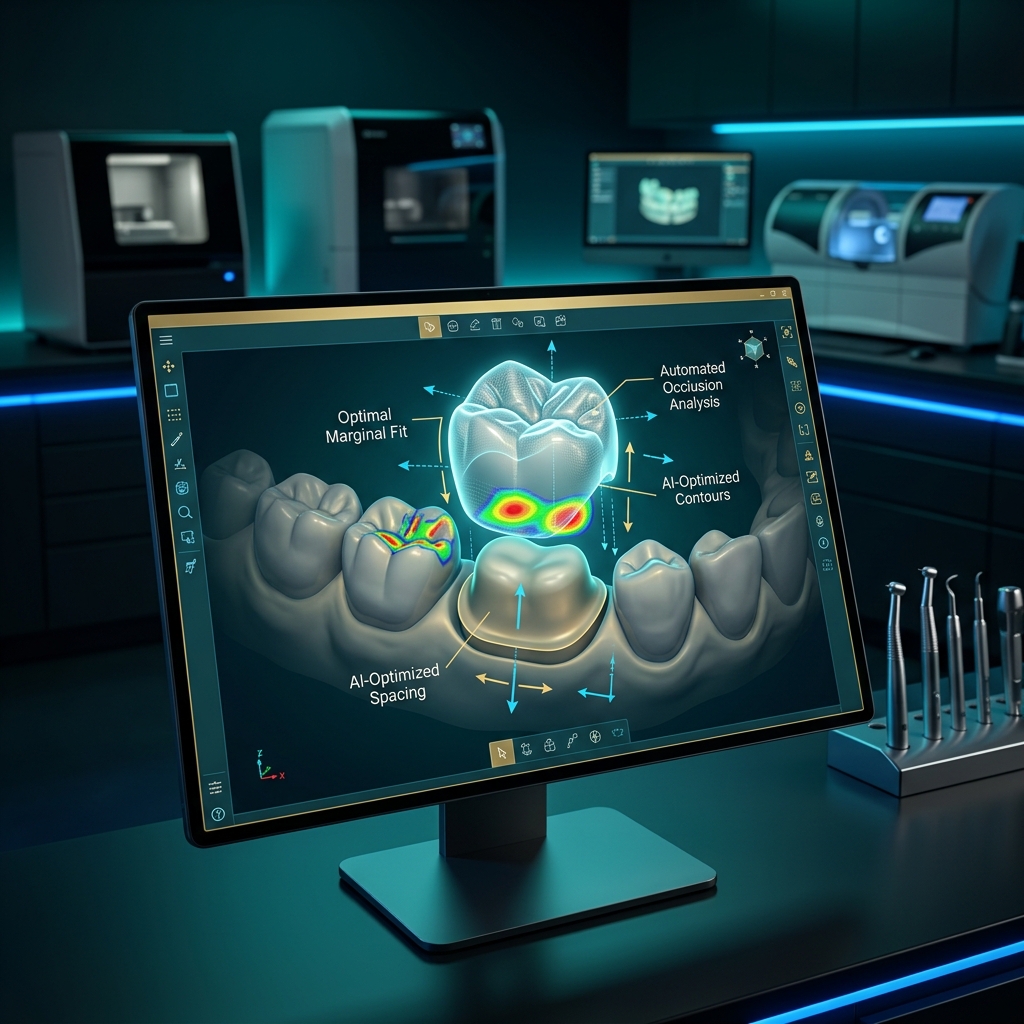
Artificial intelligence (AI)-driven automated crown design is rapidly emerging in digital restorative dentistry. A 2026 systematic review and meta-analysis published in Biomedical Engineering and Computational Biology (Holiel et al., SAGE Publications) critically evaluated whether AI-assisted systems—including deep learning (DL), generative adversarial networks (GANs), and diffusion models—produce dental crowns with comparable or superior morphological accuracy, occlusal integration, internal fit, and workflow efficiency relative to computer-aided design (CAD) or technician-driven workflows.
The authors conducted a comprehensive search across MEDLINE (PubMed), Scopus, Web of Science, Embase, and the Cochrane Library through March 2026. A total of 17 studies met the inclusion criteria, with 13 included in the quantitative meta-analysis.
2. Key Findings & Quantitative Meta-Analysis
The quantitative synthesis evaluated primary outcomes including root-mean-square (RMS) deviation, cusp morphology, occlusal contact fidelity, and internal fit, alongside secondary outcomes such as marginal adaptation and design duration:
- Workflow Efficiency: AI-assisted workflows reduced restoration design time by 25% to 50% compared to traditional technician-guided CAD workflows (p < 0.001).
- Morphological Accuracy & Internal Fit: AI systems achieved clinically acceptable morphological accuracy, internal fit, and occlusal contact reproduction. Meta-analysis using random-effects models showed a standardized mean difference (SMD) in RMS deviation of -0.15 (95% CI: -1.04 to 0.74), demonstrating equivalence to conventional CAD methods.
- Deviation Ranges: Deep learning and GAN-based platforms consistently produced crowns within clinically acceptable deviation thresholds (under 100 to 200 micrometers).
- Marginal & Chamfer Precision: Automated systems demonstrated enhanced precision in chamfer line and marginal gap reproduction (p < 0.001).
3. Discussion & Clinical Realities
While the findings demonstrate high technical feasibility and substantial time savings, the review highlights critical caveats that clinicians and researchers must consider:
- Predominantly In Vitro Evidence: Current evidence is derived predominantly from in vitro and computational studies, with limited prospective clinical validation and insufficient long-term follow-up.
- Dynamic Occlusal Challenges: Integration of patient-specific dynamic occlusal data and mandibular kinematics remains limited in current commercial AI models.
- Collaborative Human-AI Workflow: The authors conclude that findings should not be interpreted as definitive evidence of clinical superiority over experienced dental technicians. In anatomically complex cases, expert technician refinement remains beneficial.
4. Synthesis of Key Takeaways
AI helps dental laboratories design crowns faster (cutting digital design time by 25%–50%) while meeting established clinical fit and precision standards (under 100 to 200 micrometers).
Generative models (GANs, diffusion) automate initial crown morphology, but mastering tooth anatomy and occlusal dynamics remains essential for managing complex restorative cases.
AI accelerates CAD workflows with equivalent marginal and internal fit (SMD -0.15). However, evidence is largely in vitro; clinician and technician oversight remains vital.
Biomedical Engineering and Computational Biology, 2026. "Accuracy and Functional Performance of Artificial Intelligence-Based Automated Crown Design Systems: A Systematic Review and Meta-Analysis." Holiel AA, Al Nakouzi MM, Cuevas-Suárez CE, Flores-Ledesma A, Drouri S, Bourgi R.